alex@connectcoaching.net
07880 707 565
07880 707 565


Every issue since February 2025. Open any one to read it in full, or search for a topic.
Hi there,
Back in the spring I wrote to you about honesty in music, and how the records that matter most to me are the ones where someone is just being exactly what they are. Since then there's one artist I keep coming back to more than anyone else: Ren.
I love his music. In the way where you end up sending songs to people and then asking them three days later whether they've listened yet.
I want to share him with you this month, and one song in particular. It's called Hi Ren, and you can watch it below.
A gentle heads up before you press play: it's around nine minutes long and it deals directly with illness, psychosis and some very dark thoughts. It's worth it, but pick your moment.

Ren grew up on Anglesey and was making music in his early twenties when he became seriously unwell. Pain, exhaustion, dissociation. For a long stretch he was in bed for most of the day.
Over the next few years he was told it was depression. Then bipolar disorder. Then chronic fatigue. He tried the medication, the therapy, the self help, everything he was asked to try, and kept getting worse. The stress of it all led to a period of psychosis. It wasn't until 2015 that he was diagnosed with Lyme disease, and he has lived with autoimmune problems and ongoing treatment ever since.
He documented a lot of those years as they happened, in a series of videos he shared on Facebook between 2013 and 2018. They've since been pulled together into one long form film, which you can watch below. It's hard to watch in places, because you see him at his lowest, being passed from one wrong answer to the next. But it's also one of the most honest things I've seen about what illness and being misread does to a person.
He has said he wrote Hi Ren to express "all the things I wish I'd said to my doctors and therapists at the time." He released it himself at the end of 2022. It went round the world. A year later his album Sick Boi went to number one in the UK.
▶ Watch Ren's Story on YouTube
One of the things I love most about Ren is that you can't put him in a box. He started out busking on the streets of Brighton with a band called The Big Push. He raps, he sings, he plays guitar, and he'll often move through several styles inside a single song. His album Sick Boi has been described as "kaleidoscopic hip hop", which is about as close as anyone has got.
A few places to start if you want to explore:
You'll find all of them on his YouTube channel.
What ties all of it together, for me, is the same thing I wrote about in the spring. Whatever the style, he's never managing how he comes across. He just says the true thing.
Hi Ren is a conversation between Ren and the critical voice in his own head. The voice is mocking, clever and relentless. It knows exactly where to hit. Ren argues back, gets louder, gets more desperate, and for most of the song the voice is winning.
Then something shifts. He stops fighting it. He listens to it, recognises it as part of himself, and speaks to it differently.
Ren describes it as "a song about accepting your own critical thoughts so that you can live a more peaceful and happy life."
What I love about it is that it doesn't tidy anything up. The edges stay rough. It's raw, it's a bit chaotic in places, and it's all the more honest for that.
Watching Ren's Story, what stays with me isn't only the illness. It's what years of wrong answers did to him.
Every new diagnosis came with a new plan, and every plan that didn't work quietly suggested the problem was him. Not trying hard enough. Not taking the right tablets. Not thinking the right thoughts. When you're told often enough that it's in your head, you start to wonder whether the people with the qualifications know you better than you know yourself.
I hear versions of this story a lot, particularly from adults diagnosed late. Years of being told they were anxious, lazy, oversensitive or just not trying. The problem in those stories usually isn't the person. It's a system that didn't have the full picture and didn't think to ask. But being misread for that long leaves a mark. People stop trusting their own read on things, and they often stop saying how they really feel.
What strikes me about Ren is that he never fully let go of what he knew. He felt that the pain and the neurological problems pointed to something more than depression, and he kept looking for an answer even when he was exhausted and nobody seemed to be listening. That's what eventually got him to the right diagnosis.
I want to be careful here, because keeping going isn't the same as pushing through. Ren rested when he had to, lost years to being unwell, and had to stop and start more times than anyone would choose. Keeping going, in his story, means something quieter. Not giving up on your own sense of what's true. Asking again. Finding the next person who might listen.
That's something I see in coaching all the time. People who have spent years doubting themselves often turn out to have been right about more than they realised. The work is less about finding new answers and more about learning to trust the ones you already had.
Hi Ren adds another layer. Most of the people I work with have an inner voice like Ren's. It's not always as loud, but it's usually just as good at its job. And the instinct is nearly always to fight it, argue with it, or try to drown it out. That's exhausting, and as the song shows, it rarely works.
What I often notice is that the voice isn't lying so much as measuring you against an old benchmark. A version of you from before burnout, before diagnosis, or from years of masking. The useful question isn't whether the voice is right. It's who it's comparing you to, and whether that person was actually okay.
Next time that voice pipes up, try not arguing with it for a moment. Just notice it and name it. "Ah, that's the voice that tells me I'm about to be found out." Then ask what it's actually worried about.
It sounds small. But it changes the conversation from a fight into something you can work with. You stop being the voice and start being the person listening to it.
And if there's something you've been carrying on your own, say it out loud to someone. A friend, a GP, a coach, whoever feels safe. Ren's whole story is a case for saying the true thing, even when it comes out messy.

If this has stirred something up and you'd like some space to think it through, that's very much what coaching is for.
My books are full and there's a waiting list, but it does move. If it would help to talk it through, you're welcome to book a call: click here to book in
Speak soon,
Alex
Hi there,
Last week I ran the first of the new Friday coworking sessions. It went really well. People turned up, cameras on or off as they liked, and got on with the thing they'd been putting off. It was exactly what I'd hoped it would be.
It was also a day of a lot of people. New faces to welcome, a check-in round to hold, then coaching sessions through the afternoon, then family life in the evening. Nothing difficult. Nothing I didn't want to be doing. And by the evening I had nothing left, in a way that didn't match anything I could point to.
I hear a version of this in sessions every autumn, almost word for word: "I don't understand why I'm so tired. I haven't done anything."
You translated. All day.
For a lot of the neurodivergent people I work with, an ordinary conversation isn't one task. It's several running at once. Taking in what someone is saying and working out what they actually mean. Reading tone, pace, faces and what got left out. Building your reply and checking it before it leaves your mouth. And underneath all of that, monitoring how it's going and adjusting as you go.
None of it shows. From the outside it's just two people having a chat. If you'd spent the day carrying boxes, everyone would expect you to be tired, including you. An afternoon of meetings, a call you didn't plan for, a team lunch and something social in the evening reads as a day where nothing much happened.
This is the part that catches people out.
If you've been doing this for thirty years, you're probably very good at it. You read rooms well. People find you easy to talk to. And because the result is smooth, nobody, including you, has any reason to think it was expensive.
But smooth isn't the same as cheap. The polish is evidence of the effort, not evidence that there wasn't any.
It also creates a second problem. When you look fine, people respond to how you look. Your manager assumes the workload is manageable because you've never said otherwise. When you finally do say something, you get "but you always seem so on top of things", which can land as not being believed. And after enough years of everyone reading you as fine, it gets harder to trust your own sense that you aren't.
So I want to say this plainly. How you feel is real information, even when nobody else can see it. The fact that you managed the meeting doesn't mean the meeting was manageable. It means you managed it.
Start with the accounting. Interaction is work, so put it in the plan as work. Four hours of meetings, a coffee with someone you like and a thing in the evening is a full day. Planning as though the evening starts from zero is where a lot of the damage comes from.
Then sequence rather than stack. Two demanding conversations with an hour between them cost less than two back to back, even though the diary can't tell the difference.
After that, look at reducing the translation itself rather than getting better at carrying it. An agenda in advance. A written follow-up. One to one instead of a group of six. Camera off. Sending it in writing where writing is an option. None of that is avoiding people. It's taking the "all at once" out of something that only got hard because it was all at once.
And choose one or two people who get the accurate version. Not everyone needs it. But a partner, a friend or a manager you trust might, and something concrete helps more than a general "I'm struggling". For example: "I come across as fine in meetings, but I'm usually running on empty by the end. Having the agenda the day before would really help."
A lot of workplaces push translation load up almost by accident. Open plan offices. Meetings with no agenda. Decisions made in passing rather than in writing. That's a design problem, not a problem with the people struggling in it, and it changes what you go and ask for. You're not asking to be let off part of the job. You're pointing out that one format is expensive for you and a cheaper one exists.
If you want one question to take into next week: which of the things in my diary need to happen live, and which are only live because nobody ever questioned it?
If you've reached the point in the autumn where you get through the days and then have nothing left, that's a lot of what I do in sessions. We look at where the cost is really coming from, what could be moved, spaced out or put in writing, and how to ask for it in a way that sounds like you.
My books are full and there's a waiting list, but it does move. If it would help to talk it through, you're welcome to book a call: click here to book in
And if you'd like something lighter in the meantime, the Friday coworking runs fortnightly. Get in touch and I'll send you the details.
Thanks,
Alex
Hi there,
I've got two new things on the go, and I wanted to put them in front of you in case any of them are useful.
They're in one place rather than spread across three, because they're related, and because you might want one of them and not the others.
None of them are coaching. They're smaller, cheaper and much lower-commitment - a set of worksheets and a fortnightly coworking session. They exist because there's a wide gap between "I could do with some support with this" and "I'm ready to commit to coaching", and not much sits in it.
They're also, honestly, experiments. Three fairly different approaches, run at the same time, to see which ones people actually find useful.
These started as one-offs for clients. Someone needed a way to prepare for a difficult conversation with a manager, or a structure for job applications that didn't assume a neurotypical brain, or something to make sense of what burnout was actually doing to them - so I'd build it, use it in the session, and it would go in a folder.
There are enough of them now that it made sense to put them somewhere. So there's a shop: Connect Coaching Tools.
What's in there at the moment:
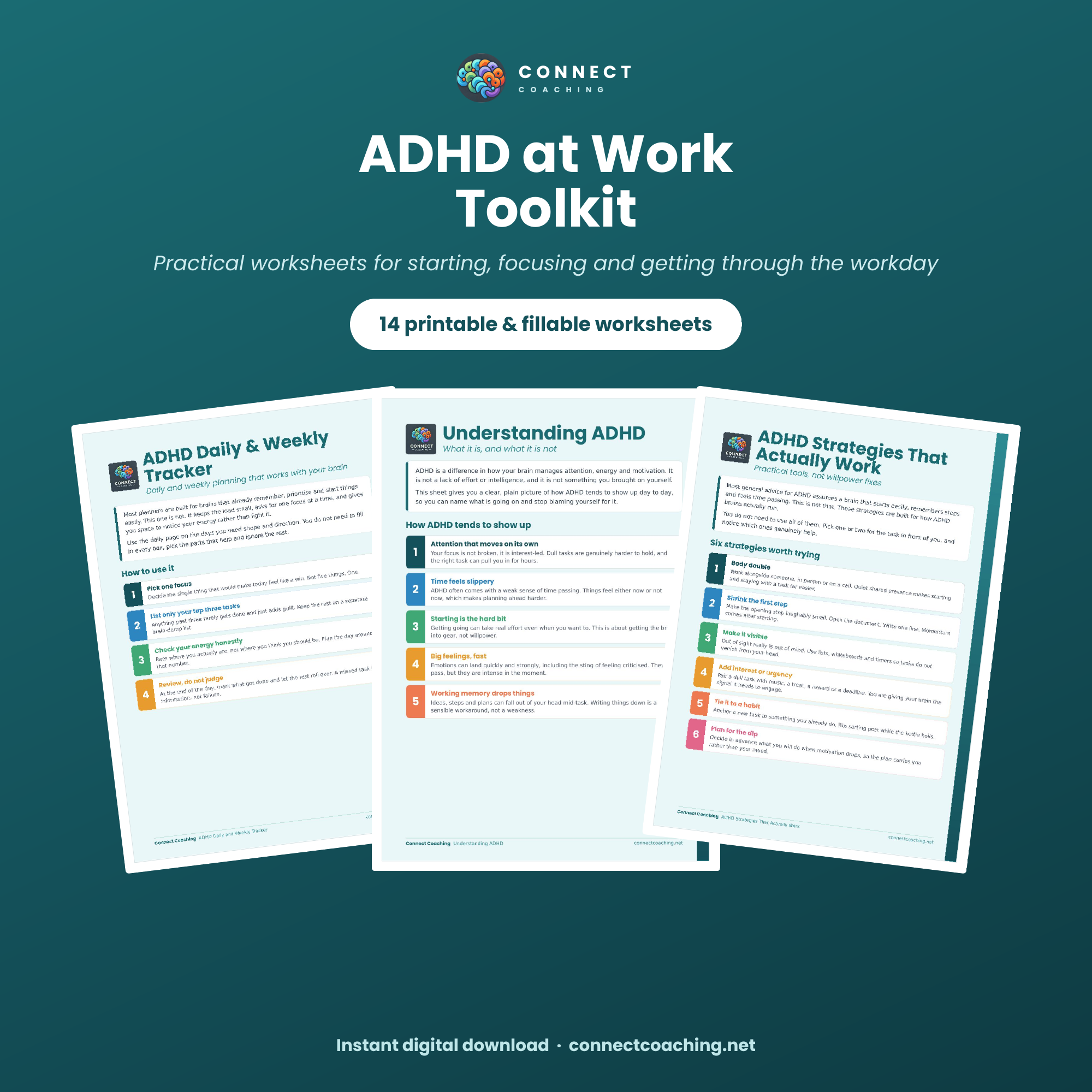
They're digital, so you download them and print or fill them in as you like. And they're the same materials I use in sessions, which means no productivity hustle and no shame built into them. If a worksheet has ever made you feel worse about yourself, it wasn't one of mine.
The shop itself is here: Connect Coaching Tools on Etsy
This one comes straight out of what I keep seeing in sessions. A lot of people I work with don't have a problem knowing what to do. They have a problem starting, and staying started, on their own. Body doubling - just working alongside someone else - does more for that than almost any technique I could teach.
So I'm running coworking sessions every two weeks, 10:00 to 11:30, online.
The format is deliberately plain. We say hello, everyone names what they're working on, and then we work. There's a check-in partway through and a short wrap at the end. You don't have to talk, you don't have to be on camera, and nobody is going to ask how your goals are progressing. It's ninety minutes where the starting is done for you.
If you're a current client, it's included - it's a free add-on, just come along.
For everyone else it's pay what you can afford. A suggested amount is £10 a session, but that is genuinely a suggestion rather than a price. Pay less if £10 isn't sensible for you right now. Pay nothing if that's where you are. I would rather you were in the room.
You sign up once and that's it - there's no register and nothing to cancel, so you come to the ones that help and skip the ones that don't.
Both do the same basic thing: take something that's expensive to do inside your own head and move it outside. The worksheets externalise the thinking so your brain doesn't have to hold it. The coworking externalises the starting so you don't have to generate it alone every time.
That's a fair bit of what coaching does too. These are just smaller, cheaper and available now.
So if you've been thinking about coaching and the timing or the money isn't right - which is a completely reasonable place to be - one of these might suit where you actually are. And if you do want to talk about coaching, you're welcome to book a call and we can work out the timing together.
Alex


Hi there,
My daughter Rosie had her last day at school last week. After a few years there, she's finished Year 11 and moving on. She wrote a leaving speech for it. All the girls in Year 11 did.
She's autistic. And the school she's just left is Limpsfield Grange, in Surrey - the only specialist state school in the country solely for autistic girls. I've wanted to write about it for a while, partly because I'm her dad and I'm proud, but mostly because being close to it has reinforced how I think about what good support actually is. Not just for children. For the adults I work with too.
So this month I want to share what I've taken from it.
To explain why it mattered, I have to go back to before she was at Limpsfield.
In mainstream school, Rosie spent most of her energy trying to be the right kind of girl. There are unspoken rules about how girls are meant to behave and interact, and she found keeping up with them exhausting in a way that's hard to describe if you've never had to do it. She'd come home wrung out and on the edge of meltdown, not because the work was too hard, but because the performance was.
And she was regularly misread. A teacher would give an instruction that wasn't quite literal, Rosie would take it at face value or not pick up on it, and she'd be marked as "not listening" or "doing her own thing". Her limited eye contact got read as daydreaming. Her honesty got mis-understood. Over and over, the message she absorbed was that the way she naturally was kept getting her into trouble - that she was, somehow, getting it wrong just by being herself.
I see the adult version of this every week in my coaching work. People who've spent decades being told, in a hundred small ways, that who they are is a bit too much or not quite right - and who have quietly concluded that the sensible thing to do is become easier for everyone else to handle.

Here's the part people don't always see. Rosie didn't simply enrol at Limpsfield. We had to fight for it, for a long time.
We knew, with the kind of certainty you only get from living alongside your child, what the wrong setting would cost her - her confidence, her wellbeing, her chance to come out the other side with real qualifications and real choices. And for a while she was in the wrong setting: a stretch in a local mainstream secondary that was never going to be able to meet her needs, where she grew more anxious, more isolated and more unhappy, and where we watched her start to shrink.
Getting her out of there and into the place that could actually help her took the best part of a year of our lives. I won't lay out every meeting and form and phone call here - if you've ever had to do it, you'll know, and if you haven't, the procedural detail isn't really the point. The point is the toll. The evenings and weekends swallowed by paperwork. The low, constant fear that we'd get something wrong, or run out of road, with her whole future riding on it. The weeks where we were putting in something like fourteen hours at the kitchen table doing the support the system wasn't, on top of our own jobs. The strain on the whole family - including her younger brother, who needed us too, and too often had to wait while we kept Rosie afloat.
It was one of the hardest things we've done. And here's what I feel is important: we were not unusual.
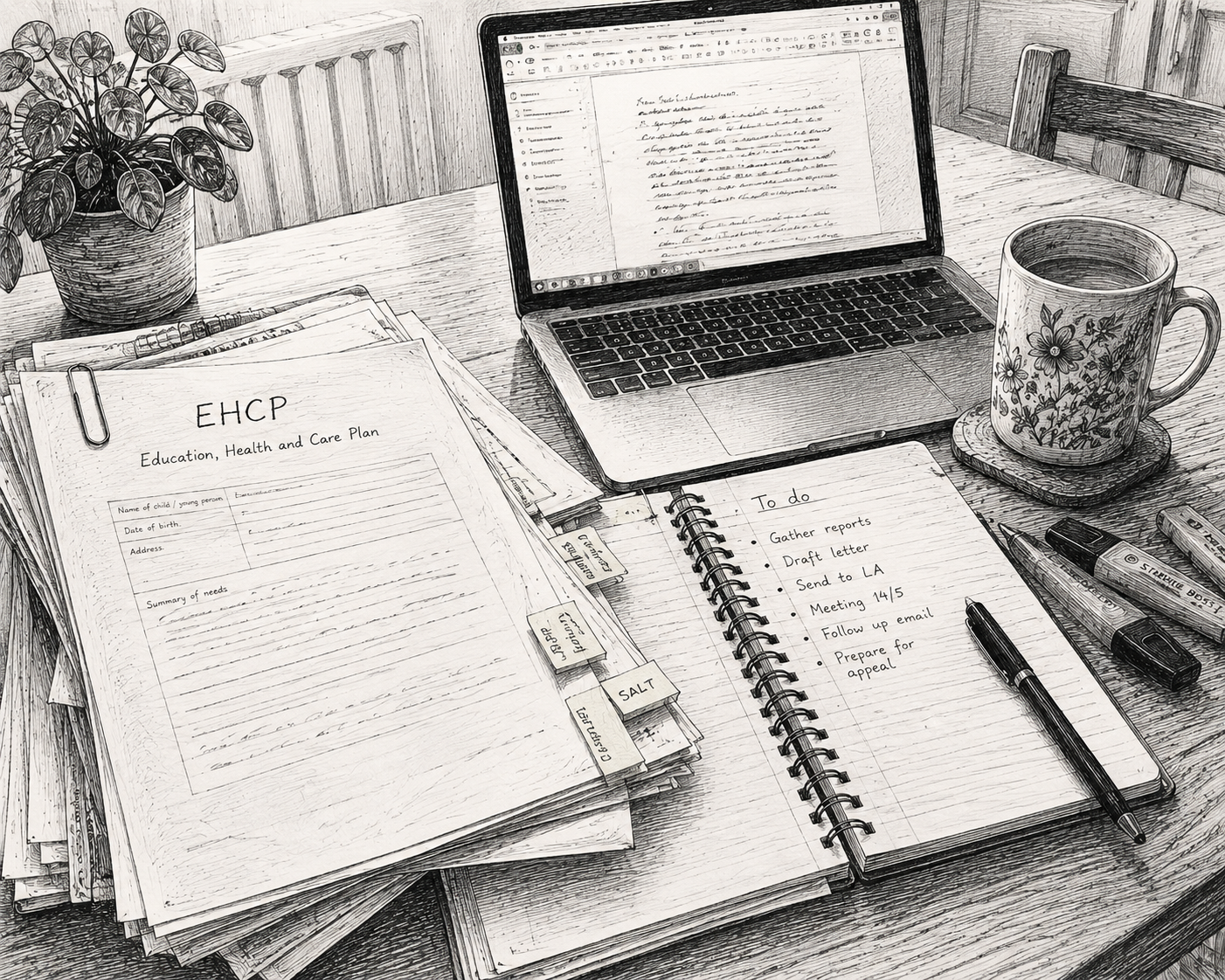
There's a line in The Shawshank Redemption where the prisoners all joke that everyone inside is innocent. At Limpsfield it's a bit like that, except everyone has fought to get in. Almost every other family has a version of the same story. The battles with the local authority. The reports, the tribunals, the months of not knowing. The sheer effort it took to get their daughter to the one place that could give her the best shot.
Every girl in that school has been through a lot to get there. So has every family. It's a building full of children who were, in one setting or another, misunderstood - and parents who refused to accept that being misunderstood was the best on offer.
That's the context I want to hold alongside everything good about the school. The support is genuinely excellent. But excellent support is not the default in the education system, and it isn't handed out freely. For a lot of these families, ours included, it had to be fought for.
So what was it, exactly, that was worth all that?
It wasn't only kindness. Smaller classes, staff who genuinely understand how autism shows up in girls, an atmosphere where Rosie didn't have to mask to get through the day - yes, all of that mattered. But the thing that mattered most is harder to see from the outside, and it's the part I'd most want to pass on.
The expectations are high. From the start, the girls are expected to navigate the school independently, to work towards real qualifications, including GCSEs, to take part, to have a go. The whole approach rests on the belief that these girls are capable of a great deal - and that the school's job is to remove the things getting in the way, not to lower the bar.
That combination is what I call effective support. Aspirational and understanding. Both at once: a genuinely positive, ambitious view of what an autistic girl can do, held together with a realistic, clear-eyed understanding of what she actually needs to get there.
What that looks like in practice is less dramatic than you'd think. Wellbeing and communication aren't bolted on as a special "social skills group" once a week - they're woven through everything, so being understood isn't a reward, it's just the baseline. Adults set clear, direct expectations rather than leaving students to decode the unspoken ones. And when something's hard, the response isn't to remove the challenge but to tailor the support.
The result is that the energy Rosie used to pour into masking and surviving has gone somewhere useful instead. Into actually learning. Into growing up. Into being her.

Rosie put it better than I can.
In her leaving speech, the first thing she landed on wasn't the academic stuff - it was the community. A school small enough that "everyone knows everyone", where she felt known. She talked about coming in barely speaking to anyone and now, a few years on, happily standing up to give a speech and planning her Silver Duke of Edinburgh (as all the girls do Bronze at Limpsfield). About trying new things she'd never have gone near before - new activities, even new foods (with firm exceptions; some things are non-negotiable). She signed off by thanking the school for its "tremendous impact" and announcing she'd now be heading off towards her "promising career as a supervillain".
That's the important bit. Not just the confidence - the playfulness. The room to be fully, unmistakably herself, out loud, in front of people. That's what the right support gets you. Not a quieter, more manageable version of the person. The actual person, with the volume turned back up.

If you're on this list, there's a fair chance some of this is familiar - either from your own life or from someone you love.
And I think the principle travels - including the difficult part. It's about what happens when someone stops having to spend all their energy proving they belong, and gets to spend it living instead. It's the difference between being tolerated and being genuinely understood. Most of the adults I work with have never had the second one. When they finally do, the change isn't that they suddenly become more capable - it's that the capability that was always there stops being buried under the effort of fitting in.
The fighting doesn't always stop at school, either. Plenty of the adults I work with are still having to advocate for themselves - for adjustments at work, for a manager who actually gets it, for the basic conditions that let them do their best. It shouldn't have to be this hard, but often it is. Part of what I do is help people work out what they actually need, and how to ask for it without burning themselves out in the process.
Because effective support, in the end, isn't lower expectations. It's the right expectations, plus a real understanding of what you need to meet them - and, often, someone willing to fight for it. That's as true at fifty as it is at fifteen.
If any of this lands, and you're at a point where you'd like to think through what the right support looks like for you - at work or more broadly - that's exactly the kind of thing we do in coaching. You're welcome to book a call. Its a free call where we could explore what might work for you.
Alex
Separately, I am exploring the possibility of running small, structured group coaching spaces.
These would be intentionally small and focused, rather than large or open-ended. I am still shaping what they might look like and would value input before developing anything further.
If this is something you would potentially be interested in, you can register interest and suggest themes you would find useful here:
https://connectcoaching.net/groupcoachinginterest
There is no commitment implied, this is simply a way for me to gauge interest and shape it properly.
Hi there,
Over the last couple of months, I've been experimenting with building small digital tools to sit alongside my coaching work. Not to replace anything - but to extend it. To give people something useful they can work through on their own time, rather than everything having to happen inside a session.
There's a part of me that finds the problem interesting - how do you take something that's inherently relational and reflective, and create something structured enough to be useful without it becoming a checklist that people tick off without thinking? The short answer is: it's hard. The longer answer is what I want to share with you today.
There are things a well-designed tool can do genuinely well.
It can work at any time. Not when I'm available, not when the session comes around - right now, at 11pm when you're spiralling about work, or on Sunday when you're dreading Monday. For a lot of people, that's exactly when this kind of structured reflection would help most.
It can create a record. Something written, something printable, something you can bring to a conversation with HR or a manager. That's genuinely useful because the verbal version - "I've been struggling" - doesn't give anyone much to work with. A structured summary does.
It can reduce the cognitive load of getting started. Some people need a scaffold before they can think clearly. A tool that asks the right questions, in the right order, can do that - rather than leaving someone to stare at a blank page.
And it's private. You don't have to manage someone else's reaction. For a lot of neurodivergent people, writing things down before speaking them is the difference between clarity and chaos.
But there are things it can't do - and I think its important to be aware of this.
A tool doesn't know what it doesn't know about you. It can ask good questions, but it can't tell when you've answered them in a way that's self-protective rather than accurate. It can't notice that the thing you described as "a minor preference" is actually the thing making your working life unsustainable. It can't push back gently when you're underselling what you need.
It can produce a list of adjustments. It can't help you work out why you feel like you don't deserve to ask for them - which is often the more important conversation.
And there's a real risk that some people will complete a tool like this and feel like they've done something, without the follow-through that actually changes anything. A beautifully formatted summary sitting unread in your downloads folder isn't progress.
So - genuinely useful in the right circumstances, with the right expectations. Not a substitute for thinking the thing through with someone
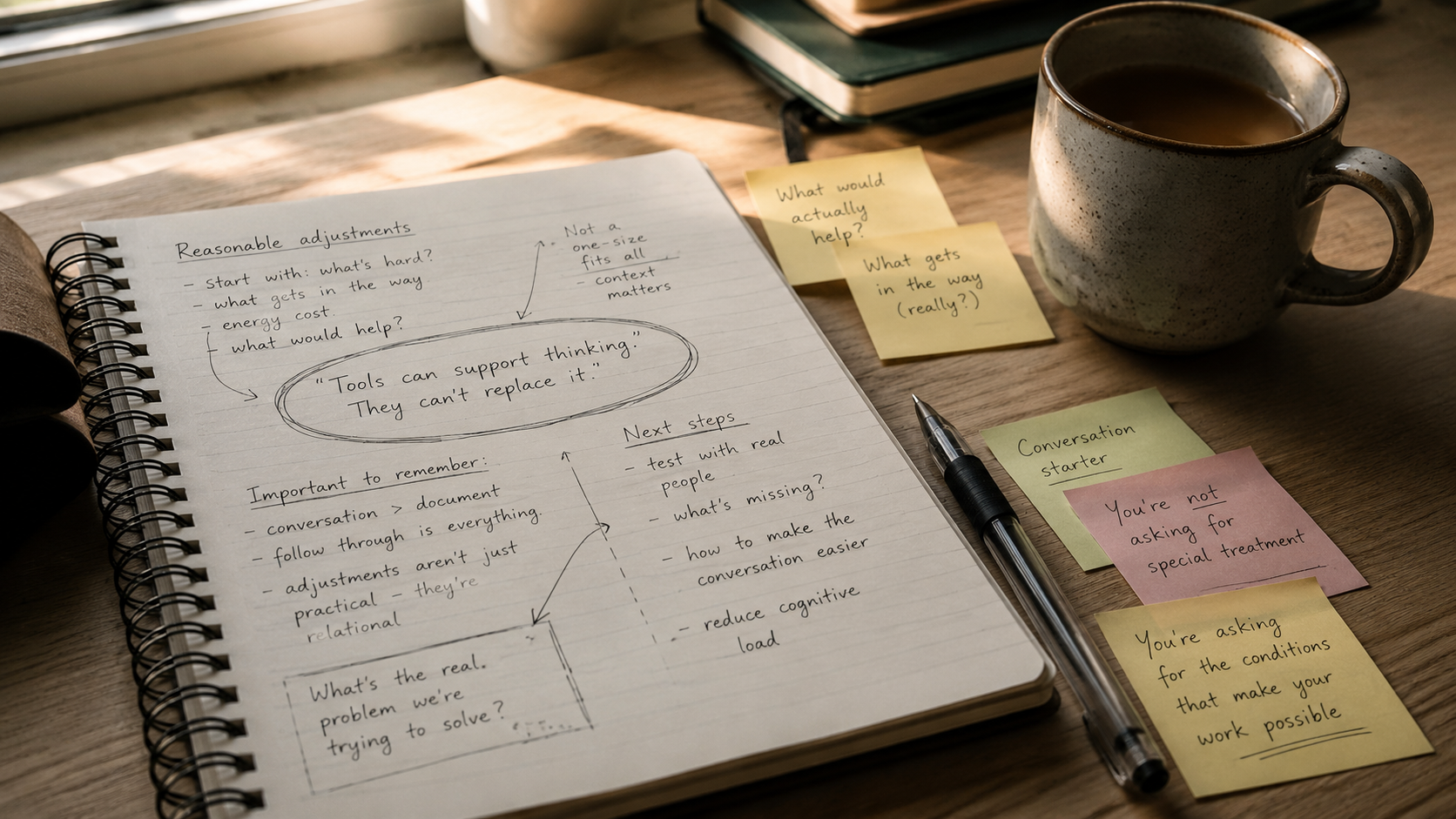
The first tool I've built is focused on reasonable adjustments at work. It's something that comes up constantly in coaching - people who know they're struggling, who know that some changes to how they work would help, but who don't know what to ask for or how to have the conversation.
The tool walks you through it in seven steps: your context, the specific things that create difficulty for you at work, a curated list of adjustments to choose from (with suggestions based on your answers), a section on how stress shows up for you - which is often really useful context for a manager - and finally the practical side: how to actually have the conversation, including draft scripts.
At the end you get a summary document. Something you can print, save, or bring with you.
It's a work in progress. There are things I'd change and things I'd add - but it's functional, and I think it does something useful. You can try it here:
Reasonable Adjustments Tool - Connect Coaching
If you do use it, I'd genuinely welcome feedback. What was useful, what was unclear, where it fell short. This is the kind of thing that gets better with real use rather than me testing it in isolation.
Whether you use the tool or not, the most important thing I can tell you about reasonable adjustments is this.
When you ask for written instructions, you're not asking for an exception. When you ask for an agenda in advance, you're not asking to be handled carefully.
When you ask for flexible start times, you're not asking for special treatment.
You're asking for the conditions that make it possible to do your job.
Most reasonable adjustments cost nothing. They require someone to stop assuming everyone works the same way. The Equality Act 2010 gives you the legal framework - your employer has a duty to make reasonable adjustments where a neurodivergent condition has a substantial, long-term effect on how you function. You don't need a formal diagnosis to start the conversation, though documentation helps if you encounter resistance.
The bigger obstacle for most people isn't the law. It's getting clear on what they actually need, and finding a way to ask for it that doesn't feel like either a complaint or an apology.
That's the gap the tool is designed to help with. And it's the gap I work in every day in sessions.
If you're in a job that's harder than it needs to be - and you've been assuming that's just how it is - it might be worth checking whether that's actually true.
As ever, if it would help to think it through with someone, you're welcome to book a call. Its a free call where we could explore what might work for you.
Alex
Separately, I am exploring the possibility of running small, structured group coaching spaces.
These would be intentionally small and focused, rather than large or open-ended. I am still shaping what they might look like and would value input before developing anything further.
If this is something you would potentially be interested in, you can register interest and suggest themes you would find useful here:
https://connectcoaching.net/groupcoachinginterest
There is no commitment implied, this is simply a way for me to gauge interest and shape it properly.

Hi there,
I like honesty in music.
I've known this for a long time without quite putting it that plainly. I don't mean music that performs its own rawness, or that's bleak for the sake of it. I mean music where you can tell the person making it is just being exactly what they are. Not managing how they come across. Not dressing things up.
Most of what I've listened to across my life has been doing some version of that. I've been thinking recently about what that actually means, and what it might say about why certain music matters as much as it does.
My whole family are Springsteen fans. The River was in the house when I was growing up - this double album about working life and family and the gap between what you hope for and what actually happens. It's not a cheerful record. But it treats the life it's describing with real care. Nobody in those songs is embarrassed about their circumstances. Nobody is dressing anything up.
That's stayed with me. There are other records in the same category - The Jam doing "Down in the Tube Station at Midnight", Chas and Dave being genuinely great songwriters who never once asked for your approval, Pulp on His 'n' Hers talking about class and aspiration and the North in a way that was specific and exact and a little uncomfortable. These are artists who decided that ordinary life was worth taking seriously as subject matter. That's not a small thing.
I came to His 'n' Hers at the point when I was leaving home and figuring things out, and it arrived at exactly the right time. Not because it was comforting but because it was honest in a very precise way about the distance between where you come from and where you think you're going. I still know most of it by heart.
There's a different thing some music does, which is to give feelings permission to be as large as they actually are rather than scaled down to something more manageable.
Funeral by Arcade Fire does this. "Wake Up" is a song that sounds like everyone you've ever loved and everything you've ever feared about losing them, played at enormous volume. It's not subtle. But some things aren't subtle, and music that pretends otherwise is lying to you.
Amanda Palmer does this too, differently. Her records are theatrical and sometimes uncomfortable and entirely themselves. "Astronaut" is a song I've played more times than I can count. She's not making it easy for you and she's not apologising for that.
I went through an intense phase with the White Stripes around this time as well - seeing them multiple times on a tour, working through the whole catalogue. What I was responding to, I think, was similar. Two people being completely and exactly what they were, no apology, no padding. There's something about that kind of focus that just cuts through.
What I've noticed is that music in this category tends to be the music that arrives at a particular moment and fits - not because the circumstances match but because the emotional register does. Something is being said at the right size.
As I've got older I've ended up gravitating toward something quieter. Folk music, singer-songwriters, people telling stories. Laura Marling, First Aid Kit, Ezra Furman, Belle & Sebastion, Max Richter. The sound gets more spare. The listening gets more deliberate.
Part of it, I think, is that I spend my working days listening to people tell me things that are true and difficult and specific to them - and what I want from music, more and more, is something that does the same. Not background. Not something to fill a room. Someone saying something real.
"Goodbye England (Covered in Snow)" is a Laura Marling song I've had on playlists for years and it still does something I couldn't quite put into words. It's not just about the lyrics. It's about the voice and what the voice is doing. Something honest being said without any attempt to make it easier to hear.
And this is also, if I'm being consistent, why Chas and Dave belong in this conversation. The craft is there. The honesty is there. "That's What I Like" is a brilliantly written song by people who knew exactly what they were doing and didn't need you to think it was sophisticated. That fits.
I don't have a tidy conclusion, which is probably fitting.
What I notice is that the music that has mattered most - from The River onwards - has been music where the person making it is just being exactly what they are. And that for people who spend a lot of energy managing how they come across, translating expectations, keeping various versions of themselves running at once - music that doesn't ask you to do any of that is a genuine relief. You don't have to decode it. You don't have to adjust to it. It just says what it says.
That's not nothing.
If you have records that work on you in this way, I'd genuinely like to hear what they are.
And if any of this connects to something you've been sitting with about your own working life or your own brain, and you think it might be worth talking through properly, you're welcome to get in touch. We can figure out together whether coaching might be useful and what that would actually look like.
If you’d like to explore working together, you can book a free introductory call here:
https://connectcoaching.net/introcall
Separately, I am exploring the possibility of running small, structured group coaching spaces.
These would be intentionally small and focused, rather than large or open-ended. I am still shaping what they might look like and would value input before developing anything further.
If this is something you would potentially be interested in, you can register interest and suggest themes you would find useful here:
https://connectcoaching.net/groupcoachinginterest
There is no commitment implied, this is simply a way for me to gauge interest and shape it properly.

Much of what I work on with my clients sits outside of what we’d normally describe as “work”.
A lot of my coaching focuses on employment. Workplace challenges. Communication. Routines. All of that.
But the reality is, everything around that matters just as much.
This is equally true in my life.
My daughter is 15 and heading into her GCSEs. She’s autistic and boards part of the week as her school is in another part of the country, so there’s a lot of planning around that.
When she’s home, we spend time working things through together.
What’s coming up.
What feels manageable.
What doesn’t.
And how to approach things in a way that actually works for her, rather than what’s expected on paper.
At the same time, my son is 13 and we’re supporting him with navigating social dynamics, friendships, and all the complexity that comes with that stage.
So there are a lot of conversations happening.
Different needs. Different contexts. Different types of support.
Often all within a short space of time.
What I’ve been noticing is how much of this is made up of really small, constant decisions.
Not big obvious ones. The smaller ones.
Do I step in here or give space?
Is this something to problem-solve, or something to just sit with?
How much detail is helpful right now?
Is this about the situation, or is it about energy levels today?
It’s a kind of ongoing assessing.
And a lot of that sits quietly in the background.
Alongside that, there’s also the practical layer.
Keeping track of:
There are moments where I’m in one conversation, holding onto something from earlier, and aware of something else that’s coming next.
And then later, I’ll have that feeling of:
“I know there was something important there…”
But it’s not fully there anymore.
I see this come up a lot in coaching as well.
People often come with work-based challenges, which makes sense.
But when we start to look a bit more closely, it becomes clear that a lot of what’s happening at work is connected to everything else around it.
The mental load.
The number of micro decisions being made throughout the day.
The amount of processing happening in conversations.
The effort of holding different expectations across different environments.
From the outside, it can look like:
But underneath that, there’s often a huge amount of effort going into making things work.
This has also been on my mind from a business perspective.
At the moment I have a waiting list.
On one hand, that’s a really positive thing. It tells me the work is valued and that people are finding it helpful.
On the other hand, it brings up a question I’ve been sitting with.
Do I expand?
Do I bring other people in?
And if I do that… what happens to the way I work?
A lot of what clients tell me they value isn’t just the outcomes. It’s how we get there.
Things like:
That’s quite hard to replicate.
Not impossible. But it’s not just about adding more availability.
It’s about holding onto the quality and the approach.
A kind of ongoing assessing.
What’s needed now?
What matters most to keep?
Where is there flexibility?
Where do I need to be careful not to dilute something that’s working?
Something I’ve been reflecting on through all of this is how much pressure there can be to hold onto everything.
To remember it all.
To track it all.
To carry it forward neatly.
But in reality, that’s a lot.
Especially when you’re already:
What’s been more helpful is shifting away from:
“I need to remember this”
towards:
“How do I make this easier to come back to later?”
Sometimes that’s just:
Not as a perfect system.
Just a way of reducing that constant background load a bit.
I was contacted recently by Joey, who’s building a tool called ClearTalk, and I’ve had a bit of a play around with it over the last week.
In simple terms, it listens to conversations and turns them into clear summaries and action points.
That might sound quite straightforward, but actually it connects to something I see come up a lot in coaching.
That experience of:
For a lot of neurodivergent people, that’s not occasional. It’s pretty consistent.
A couple of things I found helpful when I tried it:
That last part is often where a lot of energy goes, especially after meetings.
I can see this being useful in situations like:
It’s not about replacing your own understanding.
More about having something to anchor back to afterwards.
It’s currently in beta and free to use, and Joey is actively looking for feedback.
If you do try it, I’d be really interested to hear how you find it.
What works, what doesn’t, and where it actually fits into your day-to-day.
You can check it out here:
https://joeyk.riff.works/cleartalk
If this resonates, and you’re navigating some of this yourself, whether that’s at work, at home, or both, you don’t have to figure it out on your own.
This is exactly the kind of space I hold in coaching.
A place to think things through.
Make sense of what’s going on.
And find approaches that actually work for you in your day-to-day life.
If you’d like to explore working together, you can book a free introductory call here:
https://connectcoaching.net/introcall
I do currently have a waiting list, but it does move.
Separately, I am exploring the possibility of running small, structured group coaching spaces.
These would be intentionally small and focused, rather than large or open-ended. I am still shaping what they might look like and would value input before developing anything further.
If this is something you would potentially be interested in, you can register interest and suggest themes you would find useful here:
https://connectcoaching.net/groupcoachinginterest
There is no commitment implied, this is simply a way for me to gauge interest and shape it properly.

I’ve recently received confirmation that I’ve been awarded EMCC Senior Practitioner accreditation.
It’s taken around 18 months from start to finish.
Coaching remains largely unregulated. There is no protected title, no statutory minimum standard and no mandatory oversight. Anyone can describe themselves as a coach and begin practising.
That flexibility makes coaching accessible, but it also means responsibility for professional standards sits with the practitioner.
When coaching involves identity, work, mental health, power dynamics and systemic barriers (which my work frequently does) the ethical framework behind it matters. Boundaries matter. Accountability matters.
This accreditation wasn’t required in order for me to continue practising. My practice is established. I operate a waiting list. The work continues regardless.
But I felt it was important to formally recognise the level I’m operating at and to put my experience through external scrutiny.
Senior Practitioner status is not awarded on the basis of a short course or certificate alone. It requires evidence of sustained, competent practice.
The minimum criteria include:
On paper, those are structural requirements.
In practice, that means years of complex conversations around disclosure, burnout, workplace conflict, performance management, identity development and systemic inequity. It means making judgement calls carefully. It means knowing when to challenge and when to slow down. It means recognising the limits of coaching and referring appropriately.
The written submission itself was substantial. It required detailed case analysis, cross-referencing against competencies and explicit demonstration of ethical reasoning. It involved revisiting challenging situations and articulating clearly how decisions were made.
It was not a light-touch process.
Supervision is central to my work.
Not as a tick-box requirement. It is an active working space where I interrogate my practice. It is where I bring complexity and uncertainty. Where I examine how I am using power in the room. Where I consider bias. Where I test assumptions. Where I reflect on safeguarding decisions and boundaries.
Supervision prevents isolation. It ensures that difficult judgement calls are not made in a vacuum. It protects clients.
For the accreditation, I had to evidence not only that I attend supervision, but how it shapes my practice. I had to demonstrate patterns of reflection and development that arise directly from those sessions.
Client feedback was also a core component of the application.
Recent client evaluations were required, but more importantly, I had to evidence how feedback informs development. Coaching is relational. The people I work with actively contribute to how I refine my approach.
Their reflections highlight what lands well, where clarity is needed and where pacing requires adjustment. That process of refinement is continuous.
The accreditation process required me to demonstrate that feedback is not simply collected, but integrated into the ongoing development of my practice.
My stance throughout this work is grounded in the social model of disability.
I do not view neurodivergent clients as problems to be fixed. Much of the work involves examining systems, environments and expectations rather than pathologising individuals. That position has practical implications. It shapes how I frame challenges. It shapes how I approach workplace conversations. It shapes how I work with organisations and leaders.
However, holding a social model stance responsibly requires ongoing reflection. It requires clarity about scope. It requires understanding when coaching is appropriate and when therapeutic or clinical intervention is needed. It requires careful navigation when discussing systemic injustice while remaining ethically boundaried.
Within the submission, I had to evidence how I hold this stance competently and consistently. Values alone are not enough. They must be demonstrable in practice.
Coaching will likely remain unregulated for some time. Accreditation does not eliminate all risk. But it introduces structured accountability into a field that can otherwise rely heavily on self-description.
This was not about adding letters after my name.
It was about standing behind the level of experience I have built over two decades and ensuring that it is externally recognised, ethically anchored and accountable.
If you are considering working with any coach, it is reasonable to ask about supervision, accreditation, ethics and ongoing professional development. Those questions are appropriate.
This has been a detailed and steady process. I am glad to have completed it.
Separately, I am exploring the possibility of running small, structured group coaching spaces.
These would be intentionally small and focused, rather than large or open-ended. I am still shaping what they might look like and would value input before developing anything further.
If this is something you would potentially be interested in, you can register interest and suggest themes you would find useful here:
https://connectcoaching.net/groupcoachinginterest
There is no commitment implied, this is simply a way for me to gauge interest and shape it properly.
If you’re interested in one-to-one coaching or organisational work, you can get in touch directly or book an introductory call below.
I operate a waiting list for individual coaching and take on new work carefully to maintain depth and quality.
https://connectcoaching.net/avaliability
And as always, you’re welcome to get in touch if something here landed for you.
Take care,
Alex
Lately, when someone asks how I’m doing, I tend to hesitate.
Not because anything is wrong, exactly. More because the honest answer isn’t a single word. “Fine” feels too simple. “Okay” hides a lot.
What I usually mean is something closer to generally alright, a bit tired, trying to keep things steady and even that changes from week to week.
That pause has become quite informative for me. It tells me something about where my energy is, what’s been taking up space, and how much quiet adjustment has already happened before the question was even asked.

Earlier in my career, I don’t think I would have paused like that.
I was much more practised at giving a smooth answer. One that suggested competence, momentum, and coping. I’d learned how to keep going even when things felt stretched or misaligned, and how to treat tiredness or friction as something to push through rather than pay attention to.
Looking back, I was very good at functioning — less good at noticing what that functioning was costing.
These days, “doing okay” means something different.
It doesn’t mean everything is easy or calm. It means life feels broadly workable. That the balance isn’t perfect, but it isn’t constantly tipping either. It means noticing strain earlier, adjusting sooner, and accepting that capacity shifts rather than stays fixed.
Living in a neurodivergent family has shaped this more than anything else. There isn’t one shared rhythm everyone moves to. Capacity changes from person to person and from week to week, sometimes day to day. What feels manageable at one point can quietly become too much later, without a clear reason.
You learn to hold plans lightly. To expect movement rather than consistency. To treat adaptation as normal rather than as a failure of planning.

That way of thinking carries into how I spend time outside work too.
Lately, I’ve been choosing things that don’t ask very much of me. Time that feels absorbing without being draining. Social moments that are easy rather than effortful. Being outside without needing it to turn into reflection or improvement. Small, familiar activities that offer a bit of steadiness without demanding the “right” headspace.
I’ve also been trying to keep space for gentle movement - not as a routine to maintain or a goal to hit, but simply because my body feels more settled afterwards. It’s not impressive. It doesn’t come with a sense of achievement. It just helps.
For a long time, I think I believed that if something was genuinely helpful, it would feel like effort. That care had to look purposeful. That rest had to be earned.
What I’m appreciating more now are the things that lower the bar rather than raise it. Familiar patterns. Predictable pleasures. Time that restores without needing justification.
This way of relating to myself feeds directly into how I work.
When I’m coaching, I’m rarely listening for how someone can do more. I’m usually listening for where life already feels heavy, and what’s quietly drawing energy in the background. Sometimes that’s work itself. Often it’s everything wrapped around work: health, relationships, transitions, ongoing stress, the accumulation of small demands that never quite show up on a job description.
This is often the starting point in my work with clients: not “what’s wrong?” but what does ‘okay’ actually mean for you right now? And what would make life feel a little more workable, rather than more demanding?
A lot of people are carrying far more than is visible from the outside. It makes sense that things feel hard sometimes, even when nothing looks obviously “wrong”.
If you’re reading this and recognising something familiar, you might gently ask yourself:
What does “doing okay” actually look like for me at the moment?
Not what it should look like.
Not what sounds impressive.
Just what’s real.
If you’d like support exploring that in more depth, I offer one-to-one coaching for neurodivergent adults. My work focuses on helping life feel more workable, not more pressured.
You can book a free introductory call here if you’d like to talk things through:
https://connectcoaching.net/introcall
And as always, you’re welcome to get in touch if something here landed for you.
Take care,
Alex

As the year comes to a close, I’ve been noticing how much pressure there can be to sum everything up neatly. To decide whether the year was productive enough, whether enough changed, whether we handled it properly.
For a lot of the neurodivergent people I work with, that way of framing things doesn’t really fit. And if I’m honest, it doesn’t fit for me either. This year hasn’t been about big reveals or clear turning points. It’s been about steadiness, repair, and working out what is actually sustainable when energy, health, work and life don’t stay predictable.
So rather than trying to produce a tidy end-of-year summary, this feels like a good moment to pause and reflect on what’s been happening underneath the surface.

When I look back across my coaching work this year, one thing stands out very clearly. Most people weren’t struggling because they lacked insight, motivation, or strategies. They were struggling because the load they were carrying was already too heavy.
That load has looked different for different people, but some familiar patterns have come up again and again. Ongoing burnout or recovery from it. Fluctuating physical or mental health. Roles with unclear expectations or constant change. Adjustments that exist in theory but not in practice. Workplace conversations that loop without really going anywhere. And the constant effort of managing other people’s expectations while trying to keep yourself afloat.
A lot of coaching sessions didn’t start with goals. They started with people trying to explain why everything felt so hard, even though they were doing what they thought they were supposed to be doing. Often, the most useful thing wasn’t adding another strategy, but slowing things down enough to see where energy, pressure and expectations were out of sync, and starting there.
As one client put it:
“I thought we’d be working on motivation. Instead we worked out how tired I actually was.”
That shift, recognising exhaustion as the starting point rather than failure, has shaped a lot of the work this year.

Because I work with people over time, I get to see progress that doesn’t always show up as an obvious outcome. This year, a lot of progress has looked quieter and slower than people expect, but no less important for that.
For many clients, it’s been about stabilising rather than pushing forward. Building plans that can survive a bad week, not just a good one. Letting go of approaches that look sensible on paper but fall apart under real-life conditions.
One client summed that up neatly:
“It’s not that the plan was bad. It just didn’t survive a bad week.”
Others described changes that were harder to measure, but very real in how their days felt:
“I’m doing less, but I’m also panicking less.”
“I didn’t realise how much thinking I was doing before I even started a task.”
In several cases, nothing external changed straight away. Jobs stayed the same. Systems stayed frustrating. Circumstances stayed complex. What did change was how much responsibility people were carrying for things that weren’t actually within their control. Naming that often eased enough background pressure for clearer thinking and better decisions to emerge later on.
Not everything has resolved neatly. Some people are still very much mid-process. Some systems are still letting them down. But there has been movement, often towards making life more manageable rather than more impressive.
When I look back over the year, there are a few moments that stay with me. Not because they were dramatic, but because they say something about the kind of work that’s been happening.
These aren’t moments that make for a neat highlight reel, but they’re the ones that feel most meaningful to me. They reflect the quieter work of making things more manageable, and of taking people seriously in the context of their real lives.
Spending this year alongside people through coaching has sharpened a few things that now sit very firmly at the centre of how I work.
Energy management isn’t optional or aspirational. It’s necessary. Structure, when it’s done well, isn’t about control. It’s often about emotional safety. Knowing what should help doesn’t mean it will help in your context. And progress doesn’t always feel good while it’s happening.
One client captured that in-between space particularly clearly:
“I keep waiting to feel ready. I don’t think that’s happening, but things are still getting a bit easier.”
That feels like a very honest place to end a year. Not finished. Not fixed. But a little steadier than before.

I’m genuinely grateful to the clients I’ve worked with this year.
Not in a sentimental way, but in a very practical one. Coaching only works because people show up honestly, even when they’re tired, unsure, or not entirely clear what they need yet. Being trusted with that kind of openness isn’t something I take lightly. The care, thoughtfulness and effort clients bring into the space shapes the work just as much as anything I offer.
Thank you for that trust, and for the work you’ve been willing to do, even when it’s felt slow or uncertain.

Looking ahead to the new year, I’m not planning a big change. What I am doing is paying closer attention to what’s been emerging naturally from the work this year, and trying to explore it properly.
I’ll continue offering 1:1 coaching with a clear focus on energy, sustainability and pacing. This year has reinforced how important it is to build support that still holds on low-capacity days, not just when someone feels motivated or clear-headed, and that’s where I want to keep putting my attention.
Alongside that, I’ve been thinking a lot about how technology might support the work more effectively. I’ve already started developing and using things like Miro boards in sessions, and experimenting with GPTs that can help people organise thoughts, reflect between sessions, or reduce some of the cognitive load that builds up around planning and decision-making. That work is already underway, and I want to keep developing it carefully rather than rushing it.
I’m also holding a number of other ideas lightly. Things like more structured body-doubling or co-working sessions, reflective journals that people can use at their own pace, and possibly short online courses built around themes that come up again and again in coaching. There’s also a growing curiosity about whether some of this work could sit alongside more formal research into the neurodivergent experience, particularly where lived experience and practice meet.
Not all of these things will happen, and they don’t need to. But it would feel meaningful to look back in twelve months’ time and see that one or two of them have taken shape in a way that genuinely supports people, rather than adding more noise or pressure.
On the organisational side, I’ll continue working with employers around neuroinclusion, with a stronger emphasis on what actually changes day to day. That means focusing less on awareness for its own sake, and more on communication clarity, realistic expectations, and systems that don’t rely on individuals constantly compensating or explaining themselves.
Overall, my aim is for Connect Coaching to remain a steady, thoughtful space. One where complexity is allowed, where things don’t have to be rushed or neatly packaged, and where people don’t have to turn their experience into a polished story to be taken seriously.
If you’re finishing the year feeling tired, unresolved, or unsure how to summarise it, you’re not doing it wrong.
You don’t need a neat ending. You don’t need a clear plan yet. You don’t need to prove that this year counted.
Sometimes the work is simply staying with yourself through complexity, and making things a little more livable than they were before.
Thank you for reading, for reflecting alongside me, and for being part of this space. I’ll be here in the new year, continuing this work with the same care and focus as always.
Be gentle with yourself over the coming weeks, in whatever way that makes sense for you.
If you’d like to explore coaching for yourself, I’d love to hear from you.
My work is about helping you find strategies that fit your life – not forcing you into someone else’s mould. Together we can explore sustainable ways to manage energy, reduce burnout, and build confidence in how you work best.
Book a free call here: connectcoaching.net/introcall
Warmly,
Alex
Hello lovely people,
As December rolls in, so does the annual wave of advice about how neurodivergent people can “manage” Christmas. Social media fills up with tips, scripts, survival guides, and well-meaning reminders about boundaries, energy management, and sensory overwhelm.
A lot of that advice is genuinely useful. And chances are, if you’re reading this, you’ve already come across most of it.
So I’m not going to repeat it here.
Instead, I wanted to pause and talk about the part of Christmas that advice doesn’t always touch. The emotional layer. The history. The expectations that sit quietly underneath the practical planning.
Because for many neurodivergent people, Christmas isn’t difficult because they don’t know what to do. It’s difficult because of what this time of year brings up.

In coaching, I often work with people who are already well-equipped with strategies. They understand their sensory needs. They’ve thought about pacing, boundaries, and how to protect their energy. They’ve planned ahead as much as they can.
And yet, December can still feel uncomfortable, draining, or unsettling.
That’s usually because the harder parts of Christmas aren’t logistical. They’re relational and emotional. Family dynamics that only surface once a year. The pressure to participate in ways that don’t quite fit. Old roles that quietly reappear. Grief for people, experiences, or versions of life that aren’t there.
Christmas has a way of drawing attention to what’s missing as much as what’s present. It brings comparisons, expectations, and memories into sharper focus.
No amount of advice can fully smooth that out. And that doesn’t mean you’re doing anything wrong.

This is why stories can be so helpful at this time of year. They don’t offer solutions or instructions. They don’t tidy things up. And they don’t need to be about Christmas to speak directly to experiences many neurodivergent people recognise.
I wanted to share a trailer for a short film that does exactly that:
https://www.youtube.com/watch?v=SnOCAawzv6U
The film centres on Zoe, an autistic actor navigating auditions, conversations, and expectations that constantly reduce her to a stereotype. She is repeatedly asked what her “autism superpower” is. She is compared to Rain Man. She is described as “not looking autistic enough”, or alternatively as needing to be “more autistic” to fit a role. Her identity is continually filtered through other people’s assumptions about what autism should look like and how it should perform.
What the film captures so well is the exhausting, everyday negotiation that happens underneath those moments. The monitoring of how much to explain. The calculation of when to comply, when to push back, and when to stay silent. The tension between wanting to be seen as yourself and knowing that the system you’re in isn’t really set up for that.
There’s a powerful monologue near the end where Zoe talks about watching The Flintstones and The Jetsons as a child, and realising that neither the past nor the future being shown on screen had space for someone like her. It lands as a quiet but devastating observation: representation isn’t just about visibility, it’s about being able to imagine yourself existing in the world at all.
What struck me most is that the film doesn’t try to resolve this neatly. It doesn’t offer reassurance or a feel-good ending. It allows the discomfort, frustration, humour, anger, and clarity to sit side by side. It lets a neurodivergent experience exist on its own terms, without explanation or apology.
The film is currently looking for screening opportunities in the UK. Sharing it, talking about it, or helping it reach a wider audience is one small way of supporting more honest and nuanced neurodivergent storytelling. The kind that doesn’t flatten difference or turn it into something palatable, but shows it as it actually is.
Rather than more advice, I want to offer a few gentle questions you might want to sit with over the next couple of weeks. There’s no pressure to do anything with them.
You don’t need clear answers. Sometimes just noticing patterns is enough.
As we move towards the end of the year, I want to leave you with this reminder.
You don’t have to make Christmas meaningful, joyful, productive, or restorative. You’re not failing if you feel disconnected, indifferent, or simply relieved when it’s over.
Doing less is allowed. Doing things differently is allowed. Looking after your energy, your emotions, and your sense of self matters more than meeting anyone else’s expectations.
If this newsletter brings up thoughts you want to share, or if you’d like to talk about the film, I’m always glad to hear from you.
Take care of yourselves, in whatever way makes sense for you.
Warmly,
Alex
Hello lovely people,
November always feels like a quieter month to me. The light fades earlier, the evenings stretch out, and I naturally settle into slower TV that gives me space to think. I tend to gravitate towards shows that feel reflective, slightly unusual and willing to explore the parts of life most people avoid talking about.
This year, I have been watching Pluribus, which has opened up a whole line of thought around identity and the emotional lives we keep inside. It has also made me revisit two of my favourite shows for exploring internal experience: The Leftovers and Severance. All three approach the same question from different angles. What does it mean to have an inner world that does not match the one around you? And how do you keep hold of your identity when the world keeps nudging you towards sameness?
I wanted to share some reflections on these stories and how they link to the lived experiences many neurodivergent adults describe in coaching.

In Pluribus, the majority of humanity has merged into a hive-mind known as the Joining. It is peaceful, consistent and emotionally stable. Carol Sturka, a novelist, remains separate. Her thoughts, feelings, fears and instincts belong to her alone, which instantly marks her as different in a world that now values collective sameness.
What stands out is that Carol is not rebelling. She is simply trying to remain herself in an environment that has no framework for individuality. When she meets characters like Zosia, who speak with serene certainty on behalf of the hive-mind, there is a painful clarity in their interactions. The hive mind cannot understand why Carol values her private thoughts or why she clings to the emotional complexity that the Joining considers unnecessary.
This mirrors a very real neurodivergent experience. Many ND adults describe the tension of living in a world that seems to share an unspoken emotional script they were never given. The sense of being surrounded by people who all respond in roughly the same way, while your own internal reactions feel bigger, sharper or simply different. The quiet pressure to flatten yourself into something more acceptable. More predictable. More aligned.
There is a moment where the hive-mind gifts Carol a grenade. They see it as symbolic trust. She sees it as a reminder that she is fundamentally misunderstood. The contrast between their interpretation and hers is enormous, and it captures the gap many neurodivergent people feel between how others perceive them and how they actually experience life.
One client phrased it perfectly.
"I feel like my real reactions are too intense for other people, so I filter myself constantly."
Pluribus understands the loneliness of carrying an emotional world that does not easily fit into the surrounding landscape. It highlights the emotional labour of maintaining individuality in systems that reward uniformity.

The Leftovers begins with an event that changes everything. Two percent of the population disappears, and the world is forced to continue. But the show is not really about the disappearance. It is about the people left behind who are expected to carry on, rebuild and behave as if daily life can return to normal.
The characters do return to routines, jobs and social roles. But internally they are nowhere near recovered. Kevin tries to appear grounded while feeling hollowed out. Nora moves through the world with care and composure, while carrying an absence so profound it shapes every decision she makes. Matt clings to meaning with increasing desperation because the world no longer operates according to rules he understands.
Every character is living inside an emotional timeline that does not match the outside world. And the more they try to fit into the expectations around them, the more disconnected they become.
This reflects an experience I see often in neurodivergent adults. Emotional processing is rarely immediate or linear. Past burnout, sensory trauma, long-term stress and accumulated pressures can sit beneath the surface long after life has “returned to normal”. Externally, someone might be functioning well. Internally, they may still be working through an event or period that fundamentally altered them.
One client told me recently.
"I have rebuilt my routines, but mentally I am still in my trauma."
The Leftovers treats this seriously. It acknowledges the gap between external stability and internal unrest. It respects the idea that emotional life does not follow a neat schedule and that some people exist in a state of quiet aftershock long after the world has moved on.
For many neurodivergent adults, this mismatch between the outer world and the inner one is not unusual. It is a familiar part of life. And the show offers the reminder that internal complexity is not a flaw but a response to experiences that genuinely mattered.
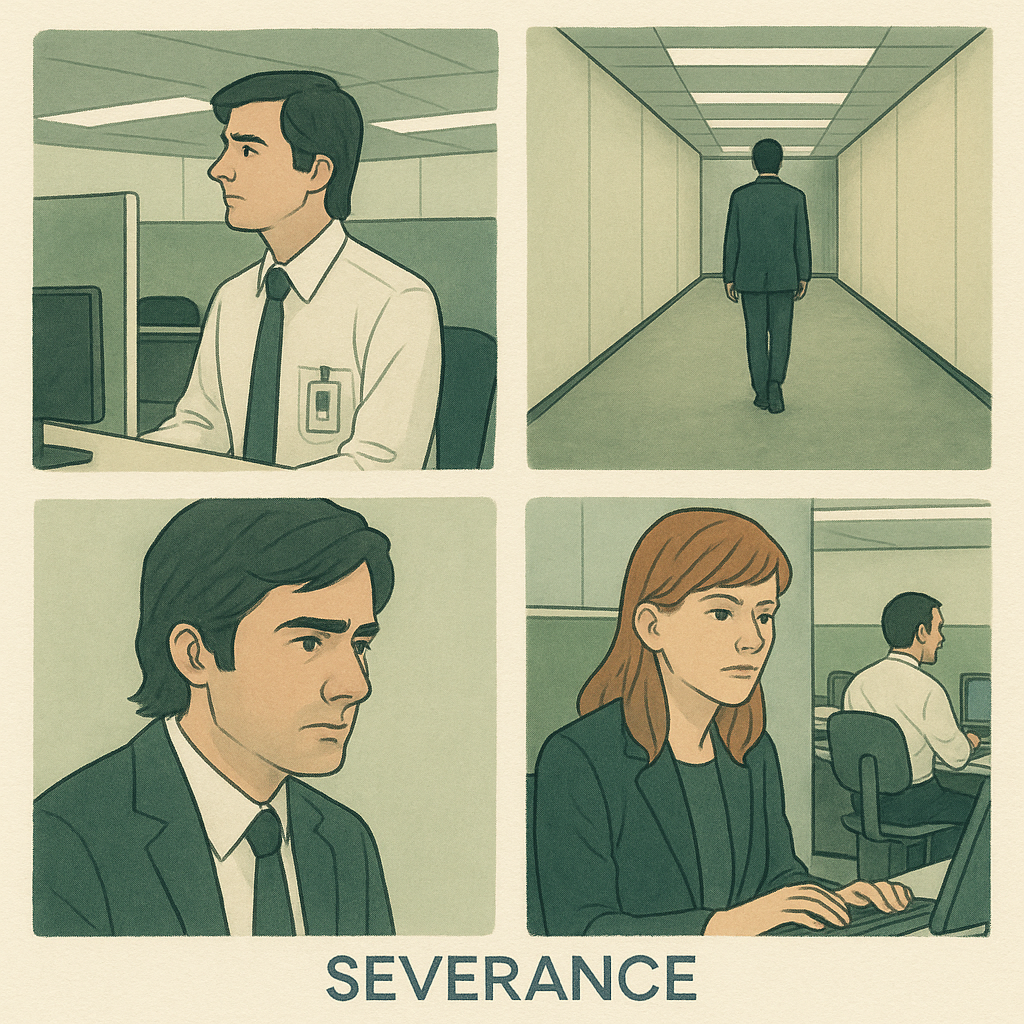
Severance imagines a world where the split between the self you show at work and the self you are at home is made literal. Through a surgical procedure, workers create a completely separate version of themselves for the office. The work identity has no access to personal memories, and the outside identity has no access to what happens inside the building.
At first glance, this seems neat. A clean divide. No emotional overflow. But the deeper you get into the show, the more the cracks appear. Mark’s grief, which he should not feel at work, starts colouring his behaviour. Irving’s rigid adherence to routine begins to look like an attempt to hold himself together. Helly’s instinctive resistance comes from a part of her that refuses to accept an identity created for her rather than by her.
So much of this reflects the lived experience of masking. Many neurodivergent people become experts at separating their professional self from their private one. At work, they appear calm, organised, capable and emotionally neutral. At home, they collapse from the effort of maintaining that version of themselves. Over time, this split becomes exhausting. And it can create a sense of being fragmented rather than whole.
In coaching, people often tell me they no longer know which version is the real one. Severance takes that experience and magnifies it, showing how unsustainable it is to live in emotional compartments. Eventually, the inner truth surfaces. The body remembers. The emotions return. And the hidden self pushes through.
The show’s central question is simple. What happens when the real you is no longer willing to stay in the background?
All three of these shows return to the same idea. Identity is shaped quietly, internally and often in places the outside world cannot see. And many people carry emotional worlds that do not neatly align with the expectations around them.
As November continues, you might find it helpful to reflect on this.
Which part of you feels separate from the world right now, and what would help that part feel seen, supported or simply allowed to exist?
And if you have a character or story that has helped you understand yourself more clearly, I would genuinely love to hear about it. Stories often give language to parts of our inner lives that would otherwise stay unspoken.
If you’d like to explore coaching for yourself, I’d love to hear from you.
My work is about helping you find strategies that fit your life – not forcing you into someone else’s mould. Together we can explore sustainable ways to manage energy, reduce burnout, and build confidence in how you work best.
Book a free call here: connectcoaching.net/introcall
Warmly,
Alex
Hi everyone,
As the days get shorter and the weather cools, I’ve been reflecting on how this season often brings a pull towards comfort, connection, and familiar rituals. For me, one of those rituals is board games. They’ve been a long-standing interest, a space where strategy meets creativity, and where the way people think, communicate, and problem-solve really comes to life.
Earlier this month, I had the chance to travel to Budapest for a few days, part mini-break, part chance to dive deeper into this hobby. There’s something fascinating about how board gaming communities, no matter where you are in the world, bring together people who think and play in completely different ways. You see the full range of human interaction: the planners, the improvisers, the rule-checkers, and the quiet observers who spot everything no one else does. It always reminds me of my coaching work: different approaches, same goal — understanding each other and finding ways to work together effectively.
That idea of communication and collaboration has been on my mind since I got back, especially after one particularly game night of Blood on the Clocktower. It’s a social deduction game that’s equal parts logic and chaos, and it ended up highlighting some brilliant (and funny) examples of how easily things can go wrong when communication gets murky.
So this month’s newsletter is all about that - what nights of laughter, confusion, and collaboration can teach us about inclusion, clarity, and the rules we all live by.
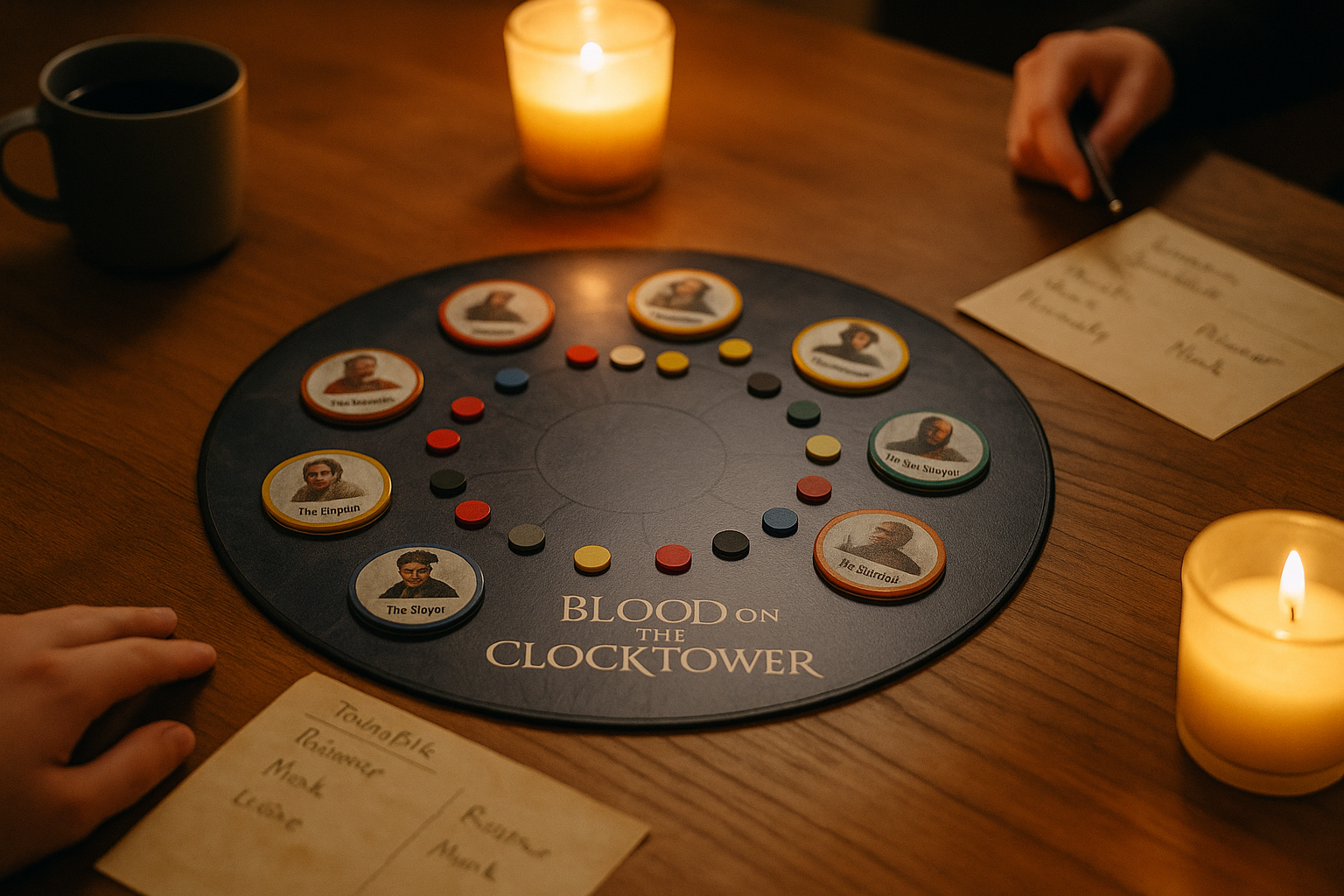
Recently, I hosted a game night with friends to play Blood on the Clocktower. It’s one of those games that’s as much about communication as it is about strategy. You spend the evening bluffing, second-guessing, and trying to work out who’s secretly working against the group. There’s laughter, confusion, and a lot of moments where everyone thinks they’ve figured it out – until they realise they haven’t.
At one point, the room was full of overlapping conversations. Everyone was speaking with confidence, but nobody was really listening. It reminded me of what happens in many workplaces and teams: people assuming they share the same information or perspective, when in reality, they’re each working with a slightly different version of the truth.
The turning point came when someone paused and asked, “Can we go over what we actually know?” It completely changed the energy in the room. Suddenly, everyone felt calmer. We had a shared foundation again. It didn’t make the game less fun – it made it fairer and more engaging.
That moment stayed with me. In coaching, I see the same principle play out all the time. Clarity doesn’t remove creativity or connection – it makes them possible. When everyone understands the “rules of the game”, they can relax, contribute, and communicate more authentically. Whether you’re managing a team, working on a project, or just navigating everyday conversations, clarity is rarely about control. It’s about creating space for people to feel safe enough to collaborate.

One thing I love about board game is that it works best when everyone knows the rules; not just the technical ones, but how the group wants to play. Do we want a chaotic, fast-paced game where anything goes? Or do we prefer something more structured, where people get time to think before they speak?
It’s a great reminder that clarity is inclusion. In coaching and workplaces alike, many misunderstandings don’t come from disagreement, but from assumptions. We assume people communicate the same way we do. We assume silence means agreement. We assume people feel safe enough to speak up when something doesn’t make sense.
For neurodivergent people, those assumptions can make daily communication exhausting. The emotional effort of decoding tone, reading between the lines, or guessing expectations adds up quickly. Just like in the game, things flow much more easily when everyone understands what’s happening and what’s expected of them.
Clear communication doesn’t mean stripping away personality or spontaneity - it means making space for everyone to contribute confidently. Saying, “Would you like me to summarise this?” or “Would it help to write that down?” can turn a muddled situation into a fair one.
When people understand the “rules of play,” they don’t have to mask, guess, or overthink. They can focus on connecting, and that’s where real collaboration starts.

During games, something interesting always happens once everyone’s on the same page. The tension drops, the laughter returns, and people start to take part more freely. It’s not about who’s winning or losing, it’s about everyone feeling safe enough to play.
That same feeling is what psychological safety looks like in real life. It’s the point where people no longer have to second-guess themselves or spend energy working out the “unwritten rules.” When expectations are clear and communication is open, people can relax into being themselves.
Structure often gets misunderstood as restrictive, but in practice, it’s what gives freedom its shape. A shared plan, clear communication, or simply checking that everyone understands what’s happening can make a huge difference, especially for neurodivergent people who might otherwise spend valuable energy decoding tone, pace, or social cues.
In both games and workplaces, clarity transforms confusion into collaboration. When people know the boundaries, they feel safe to experiment. They can focus on creativity, connection, and trust - the real building blocks of inclusion.
What I love most about moments like that game night is how they remind me that connection doesn’t have to be complicated. Whether it’s a team project, a coaching session, or a group of friends trying to outsmart one another around a table, so much depends on shared understanding.
Inclusion often starts with small acts of clarity: taking time to explain the “why,” checking that everyone feels part of the process, or noticing when someone’s gone quiet and might need space to rejoin. These things don’t require grand gestures — just awareness and kindness.
The older I get, the more I see that structure and clarity aren’t the opposite of creativity or fun. They’re what make creativity possible. They’re the reason everyone feels safe enough to play, contribute ideas, and bring their full selves into the room.
So, as the evenings draw in and the pace slows a little, maybe it’s worth asking: what helps your version of collaboration feel easier? Where might a bit more clarity - in how you communicate, plan, or connect - make things flow more smoothly?
If you’d like to explore coaching for yourself, I’d love to hear from you.
My work is about helping you find strategies that fit your life – not forcing you into someone else’s mould. Together we can explore sustainable ways to manage energy, reduce burnout, and build confidence in how you work best.
Book a free call here: connectcoaching.net/introcall
Warmly,
Alex
Hi,
A warm welcome to new subscribers.
Many of you are navigating workplace pressures, fluctuating energy, identity exploration, and the quiet weight of feeling misunderstood. You’re not alone. This month’s edition shares reflections and strategies drawn from real conversations in my coaching work and the wider community.

Earlier this month I joined an architecture tour of the Barbican in London. The estate was designed as a “mini-city” - with homes, gardens, walkways, and culture all connected. It wasn’t just about buildings, it was about creating community.
It reminded me that design shapes belonging. When environments are built with people in mind, they create support without anyone needing to ask for it.
That’s the essence of neuro-inclusion too. Too often, adjustments are treated as add-ons. Real inclusion works best when it’s built into the structure from the start - so belonging is the default, not something people must fight for.

Many of the people I work with are described as brilliant professionals – they deliver projects, lead teams, and appear confident. Yet privately they talk about masking exhaustion, battling executive function demands, or living in fear of being “found out.”
Being articulate or productive doesn’t mean someone isn’t struggling. Behind the “high-functioning” label, many are quietly burning out.
A few shifts that help:
For employers: performance is not the same as wellbeing. For neurodivergent professionals: you don’t have to burn out to be valued. Sustainability matters.

September carries a familiar “back-to-school” feel. Work ramps up, public spaces fill, and expectations rise. Even if your calendar looks the same, the environment around you has shifted.
For many neurodivergent people, this can mean noisier commutes, disrupted routines, and increased social demand. Sometimes the signs are subtle – irritability, cancelling plans, or a stronger need to control your environment.
These aren’t weaknesses, they’re signals that your system is adjusting.
What helps is building in transition rather than expecting instant adjustment:
There have also been important leadership changes recently in the neurodivergent community.
David Perkins, founder and Director of AS Mentoring, has played a transformative role in shaping employment support. Before founding AS Mentoring in 2013, he ran Prospects at the National Autistic Society, supporting thousands of autistic adults into meaningful work. David was a valued mentor as I worked with AS Mentoring and then as I built Connect Coaching, and his clarity and generosity continue to shape my approach.
James Cusack, CEO of Autistica, has been a powerful advocate for centring lived experience in research and ensuring that studies are ethical, relevant, and impactful. Under his leadership, Autistica helped shift national conversations on autism away from outdated narratives and towards community voice.
Both show how much leadership matters. When lived experience, strategy, and compassion meet, the impact reaches far beyond one organisation.

I’ve had a few enquiries recently from people curious about becoming coaches. While I don’t provide training in this area, here are some reflections to consider if this is a path you’re exploring.
Coaching is skills-based, not script-based. Deep listening, thoughtful questioning, and creating reflective space are far more important than memorising frameworks.
Training matters, but alignment matters more. Courses vary in length and style. The key question is whether the training reflects the kind of coach you want to be and the people you most want to support.
Support systems are essential. Coaching can be emotionally demanding, and supervision, peer networks, and reflective practice help keep it sustainable.
If you’re curious, start small. Try informal reflective conversations, ask for feedback, and notice what feels natural. Those early steps will give you a better sense of whether this path is right for you.
If any of these themes resonated and you’d like to explore coaching for yourself, I’d love to hear from you. My work is about helping you find strategies that fit your life – not forcing you into someone else’s mould. Together we can explore sustainable ways to manage energy, reduce burnout, and build confidence in how you work best.
Book a free call here: connectcoaching.net/introcall
Until next time, keep working in ways that work for you,
Alex

Hi there,
First off, a very warm welcome to those of you who’ve just joined my mailing list. Its been great to see s many new people join the list. I hope you find my emails useful. Just as a reminder, I am always interested to hear your thoughts - so anything that has been especially helpful, or things you would like me to include, do get in touch.
I know that summer can bring mixed feelings. For some, it’s a welcome break. But for many neurodivergent adults I work with (and personally relate to), it can also feel unstructured, overwhelming, and full of invisible pressure.
There’s often a sudden change in pace; whether it’s school holidays, colleagues being away, or just the shift in energy that comes with longer days and hotter weather. Social media ramps up, people seem endlessly active and productive, and it can feel like you’ve missed the memo on how to enjoy it all.
So if you’re feeling a bit scattered, out of rhythm, or just “off” right now, you’re not alone. This edition of the newsletter is full of real-life insights and tools I use in my coaching work (and in my own life) that might help steady things a little.
One of the most common patterns I see with clients is assuming that being tired means they didn’t sleep well. But that’s rarely the whole story. Energy is affected by things like sensory load, decision-making, masking, transitions - even the weather.
Recently, one client told me: “I slept for 9 hours, but after the office social, I felt like I’d run a marathon.” That made total sense. She’d spent the evening interpreting cues, regulating facial expressions, trying to be “on.” That’s energy too. It just isn’t recognised as such.
Try this:
I do this myself. For me, admin is an early morning job, but anything emotionally demanding has to wait until later. It’s not laziness. It’s knowing how I work best.
Another theme that comes up constantly: the sheer number of decisions we make daily. And I don’t mean the big stuff; I mean the silent, constant stream of what to wear, when to reply, how to say no, what to eat, which tab to close, what to prioritise.
Last week, someone I coach said: “It took me 45 minutes to reply to a one-line message. I just didn’t have the brain for it.” We explored why and it turned out the pressure to be polite, clear, and quick had created a bottleneck.
A few things that help:
Personally, I have a set of meals on rotation, and a “good enough” response folder I copy-paste from. I find it useful not to have the cognitive load of thinking about everything all the time. It is not always completely successful but I find it helpful overall.
This is a big one. So much of the work neurodivergent people do never gets seen, let alone recognised.
The pre-meeting prep, the emotional regulation in a busy café, the recovery time after holding it together through a family gathering - all of it takes effort.
And when no one else sees it, it’s easy to feel like you’re the problem. You’re not.
This week, try:
When I first started tracking this, I was stunned at how many things I considered “small” were quietly using up all my capacity.
Best wishes,
Alex
Hi there,
I wanted to share a couple of reflections that might resonate if you’ve felt stuck, exhausted, or just a bit out of sync lately.
Let’s talk about something I see all the time in my coaching work—the invisible effort neurodivergent people put in just to get through a day.
It’s the mental prep before a phone call.
The planning for every outcome before a meeting.
The way you double-check your tone, reread your messages, and mask your real energy in a group setting.
All of that takes time. It takes energy. And often, no one sees it.
This kind of effort is real, even if it doesn’t appear on a to-do list. And without proper recovery, it builds into chronic exhaustion that’s hard to explain, even to yourself.
💡 Try this:
Productivity advice is often built for people who thrive on routine, consistent energy, and neat task lists. But if your brain doesn’t work that way, those systems can leave you feeling like you’re constantly falling behind.
Neurodivergent productivity might look like:
That’s not failure, it’s difference.
💡 Try this instead:
Whether you're figuring out your next step, working through burnout, or learning how to live more in tune with your needs, I offer 1:1 coaching that meets you where you are.
We can focus on:
Book a free call: https://connectcoaching.net/introcall
Thanks, as always, for reading.
Whether you’re a client, a colleague, or quietly following along, I’m glad you’re here.
Warmly,
Alex
Hi there,
I’ve been having more and more conversations lately about the gap between awareness and action, especially when it comes to inclusion. This month’s newsletter talks about that: the workplaces that say the right things but fall short, the systems that make work harder than it needs to be, and what we can start doing differently.
These conversations all come back to the same core question: what does meaningful support and inclusion really look like?
This month, I’m unpacking two big areas where many individuals and organisations are still getting stuck—performative inclusion without follow-through, and the structures that quietly exclude neurodivergent people, even in "inclusive" workplaces.
Let’s be honest: awareness is great, but awareness without action doesn’t change lived experience.
What we’re often seeing is neurodiversity-lite:
When inclusion stops at messaging, neurodivergent people are left navigating the same inaccessible systems with a slightly nicer slogan.
What real inclusion looks like:
If you're ready to move from surface-level awareness to real, structural change, I offer training and consultancy for organisations that want to get it right.
Drop me a message or visit connectcoaching.net to find out more.
Even in workplaces that say the right things, many neurodivergent people are still burning out.
Why? Because the structures haven’t changed.
We’re seeing more return-to-office mandates that ignore the access remote work created. We’re seeing recognition still go to those who speak up most, not those who contribute most meaningfully. We’re seeing adjustments delayed, denied, or only offered once people reach breaking point.
Inclusion shouldn’t require resilience. It should make resilience less necessary.
Some of the hidden barriers:
Neuroinclusion is about design, not exception. It’s not something you bolt on, it’s how you build.
Whether you're figuring out your next step, working through burnout, or learning how to live more in tune with your needs, I offer 1:1 coaching that meets you where you are.
We can focus on:
Book a free call: https://connectcoaching.net/introcall
Thanks, as always, for being part of this community.
Take care, Alex
Hi there,
This month’s newsletter focuses on communication and connection, the kind that helps neurodivergent people feel safe, seen, and supported. Whether it's in how we disclose at work, the way we receive and process information, or how we access the right support, clear, compassionate communication matters.
Workplace disclosure isn’t a one-off moment, it’s a layered, ongoing process that plays out differently depending on your role. For neurodivergent employees, the decision to share personal information at work can be complex. For managers and leaders, how you respond shapes whether that space feels safe.
Let’s break it down with some practical tips at each level.
Disclosure can feel like a risk, but it can also be a path to more understanding and better support. It’s completely valid to choose when, how, and how much you share.
🧠 Tips if you’re considering disclosing:
You may be the first person someone opens up to and how you respond matters. You don’t need to have all the answers, but you do need to be open and curious.
💡 Tips for supportive conversations:
You shape the culture. If people don’t feel safe to disclose, they won’t and inclusion efforts won’t reach the people who need them most.
🏛️ Ways to build a disclosure-friendly culture:
🌱 Final Thought:
Disclosure is not just about sharing personal information, it’s about building mutual understanding, trust, and systems that support different ways of working. When all levels of an organisation approach disclosure with flexibility and care, it stops being a “scary conversation” and becomes part of everyday inclusion.
For many neurodivergent people, clarity and context aren’t just “nice to have”, they’re essential. Gaps in information can create stress, confusion, and missed expectations. On the other hand, when people are given the detail they need, they can process, plan, and engage far more effectively.
Sharing information doesn’t mean overexplaining. It means recognising that not everyone can fill in the blanks, and they shouldn’t have to.
When you’re expected to work with vague instructions or unclear expectations, it’s okay to ask for what you need.
🧠 Tips to advocate for more clarity:
This isn’t about being difficult, it’s about setting yourself up for success.
Whether you’re giving instructions, making plans, or offering feedback, a little extra clarity goes a long way.
💡 Tips for clearer communication:
Being clear is not patronising, it’s inclusive.
If you’re part of building systems, leading meetings, or setting expectations, your approach to information-sharing shapes how safe and supported others feel.
🏛️ Tips to build clarity into your culture:
Creating clarity isn’t about controlling the message, it’s about creating access.
🌱 Final Thought:
Neurodivergent people often thrive when the “rules of the game” are visible. Sharing information clearly, without ambiguity, urgency, or unspoken expectations can be the difference between confusion and confidence.
If any of this sounds familiar—and you’re ready to make some changes that actually work for your brain—I offer 1:1 coaching for neurodivergent adults who want more clarity, balance, and confidence in how they work and live.
We might focus on:
✔ Managing overwhelm without masking
✔ Building sustainable routines
✔ Navigating career changes or burnout
✔ Creating systems that support your energy and executive function
📞 Book a free intro call here: https://connectcoaching.net/introcall
You don’t have to force yourself to work the way other people do. Let’s figure out what works for you.
Take care,
Alex
Hi there,
This month I’m exploring two challenges that come up often in coaching conversations, especially for neurodivergent adults:
✔ Feeling constantly under pressure to respond, perform, or produce
✔ Struggling to make decisions—not big ones, but the constant pile-up of little ones
These aren’t just quirks or bad habits. They’re often rooted in systems and expectations that don’t fit how our brains work. So this month, let’s break them down—and find some better ways forward.
There’s a phrase I hear a lot: “I feel like I’m constantly behind.”
Urgency culture—the pressure to respond instantly, work at full speed, and “always be on”—is everywhere. Emails come with “just following up” after 24 hours. Social media tells us we need to be publishing, promoting, and reacting every day. At work, requests are labelled urgent when they really aren’t. And if you’re neurodivergent, this pressure doesn’t just create stress—it can cause total shutdown.
🔸 Why it hits harder:
🔸 You are allowed to:
🔸 Small scripts that help:
Urgency culture rewards speed over thought. But neurodivergent ways of working—slow, deep, deliberate—can actually be more sustainable, creative, and insightful.
It’s 8am. You haven’t even left the house, and you’ve already had to decide:
If that sounds familiar, you’re not alone. Decision fatigue is the exhaustion that comes from having to make too many choices too often—and for neurodivergent people, this can build up fast.
🔸 What it feels like:
This isn’t about being indecisive. It’s about cognitive load—and when your brain is already working hard to regulate sensory input, emotions, or executive function, small decisions feel enormous.
🔸 Tips to reduce decision fatigue:
✅ Create ‘defaults’ – rotate the same 3 breakfasts, wear a ‘uniform’ outfit you feel good in, have go-to meals or social scripts
✅ Limit your options – only look at 3 options instead of 10, or ask someone to shortlist for you
✅ Batch decisions – plan your week’s meals, outfits or admin all at once
✅ Use binary choices – instead of “what should I do today?” try “do I want to do this now or later?”
✅ Use visual prompts – whiteboards, task lists, and pre-set routines reduce mental juggling
🧭 One powerful question: What decisions do I make on repeat that could be automated, prepared in advance, or removed altogether?
If any of this sounds familiar—and you’re ready to make some changes that actually work for your brain—I offer 1:1 coaching for neurodivergent adults who want more clarity, balance, and confidence in how they work and live.
We might focus on:
✔ Managing overwhelm without masking
✔ Building sustainable routines
✔ Navigating career changes or burnout
✔ Creating systems that support your energy and executive function
📞 Book a free intro call here: https://connectcoaching.net/introcall
You don’t have to force yourself to work the way other people do. Let’s figure out what works for you.
Take care,
Alex
Hi there,
This month, we’re focusing on practical strategies to help with procrastination, decluttering, goal setting, and relationships. Whether you’re looking to get more done, clear some space (physically or mentally), or strengthen your connections with others, this newsletter is full of realistic, neurodivergent-friendly approaches to support you.
Let’s get started.
Procrastination isn’t about laziness—it’s often a response to overwhelm, perfectionism, or executive function challenges. If you find yourself putting things off, these strategies can help make getting started easier.
Big tasks can feel unmanageable, but breaking them down into specific, small steps makes them easier to approach.
💡 Example: Instead of “sort out my finances,” break it into:
✔ Find my bank statements
✔ Log in to my online banking
✔ Make a list of upcoming bills
By starting with one small step, you can build momentum without feeling overwhelmed.
If a task will take less than two minutes, do it straight away. It stops small things from piling up.
💡 Example: Replying to a quick email, washing a mug instead of leaving it in the sink, or setting up a direct debit—all tiny things that can make a big difference.
Body doubling—working alongside someone else, either in person or on a video call—can boost motivation and make tasks feel less daunting.
💡 Example: A client who struggled to start admin tasks now schedules co-working calls with a friend. They both work on their own tasks in silence, but having someone else present helps them focus.
Using a timer (such as the Pomodoro technique—25 minutes of focus, then a 5-minute break) can reduce pressure and make starting easier.
💡 Example: If you’re struggling to start writing, set a timer for just 5 minutes. Even if you don’t feel like it, you’re more likely to keep going once you’ve started.
📌 Takeaway: Procrastination is often about how a task feels in the moment. Making tasks smaller, easier, or more structured can help shift your mindset.
For many neurodivergent people, traditional decluttering advice doesn’t work. Struggles with object permanence, decision-making, and emotional attachment can make getting rid of things feel impossible. Here are some realistic approaches to decluttering in a way that works for your brain.
Instead of trying to declutter a whole room, choose one thing to sort, move, or get rid of.
💡 Example: A client I worked with started by removing one unused mug from their cupboard. That tiny action helped them build momentum without the pressure of a full clear-out.
If you forget things exist once they’re out of sight, use transparent storage boxes, open shelving, or labelled baskets to keep important items visible.
💡 Example: Someone I know constantly misplaced their wallet—until they put a tray by the front door. Having a specific, visible spot reduced stress.
If you struggle to let go of things, put them in a box and set a reminder for three months later. If you haven’t needed or thought about them, they can go.
💡 Example: One person I spoke to struggled to part with old clothes. They packed them into a suitcase for three months. When they realised they hadn’t missed them, donating them felt much easier.
Decluttering with a friend or even on a video call can make it easier to stay on track.
💡 Example: A member of the AuDHD community shared that they FaceTime a friend while tidying up for 10 minutes. Having company made it less overwhelming.
📌 Takeaway: Decluttering doesn’t mean getting rid of everything—it means creating a space that works for you.
Many goal-setting systems assume consistent energy levels and motivation, which isn’t always realistic for neurodivergent people. Here are some alternative ways to approach goal setting that might work better.
A classic framework, but still useful. SMART goals are:
✔ Specific – What exactly do you want to do?
✔ Measurable – How will you track progress?
✔ Achievable – Is it realistic?
✔ Relevant – Does it align with what you actually want?
✔ Time-Bound – When do you want to complete it?
💡 Example: Instead of saying, “I want to exercise more,” try:
“I will do a 10-minute walk three times a week for the next month.”
If long-term planning feels overwhelming, try categorising goals as:
✔ Now – What you’re actively working on
✔ Next – What’s coming up soon
✔ Later – Things you want to do eventually
💡 Example: If your big goal is to change jobs, your Now goal might be updating your CV, Next could be researching job openings, and Later might be applying.
Seeing your goals laid out can help with motivation and focus.
💡 Example: Someone I know uses sticky notes on a whiteboard—each note represents a step in their goal. Moving them from ‘To Do’ to ‘Done’ makes progress more visible.
📌 Takeaway: The best goal-setting method is the one that feels achievable and keeps you engaged.
Neurodivergent relationships—whether romantic, platonic, or family-based—can have unique challenges, particularly around communication, sensory needs, and emotional processing. Here are a few things that help.
Many neurodivergent people struggle with indirect communication. Saying exactly what you mean can prevent misunderstandings.
💡 Example: A client told their partner, “If I say I need alone time, it’s not because I’m upset—it’s just how I recharge.”
If certain sounds, textures, or lights make you uncomfortable, let people know.
💡 Example: One person I worked with struggled with loud TV volume, so they asked their partner to use headphones or turn on subtitles instead. Small adjustments like this can make a big difference.
Some people need space to process emotions, while others need immediate reassurance. Finding a middle ground can reduce stress.
💡 Example: A neurodivergent couple I know uses a "pause phrase"—one partner can say "I need 20 minutes to process, but I’ll come back to talk after." This stops disagreements from escalating.
📌 Takeaway: Communication, boundaries, and self-acceptance are key to navigating relationships as a neurodivergent person.
If you’d like support with procrastination, goal setting, decluttering, or relationships, I offer 1:1 coaching tailored to neurodivergent needs.
📞 Book a free call to see how coaching could support you: Book Now
Thanks for reading! If you want to tell me what resonated most with you, get in touch, I’d love to hear your thoughts.
Take care,
Alex
No issues match that search. Try a different word.
